Stanford University」タグアーカイブ

The Pi Network Explained: Potential and Challenges of the Stanford-Backed Project

仮想通貨市場で注目される「Piネットワーク」は、その革新的なモバイルマイニング技術とスタンフォード大学との提携で話題です。本記事では、このプロジェクトの技術的特徴、現在直面している課題、そして未来の可能性について詳しく解説します。

Stanford University Partnership: Proof of Reliability

Pi Network is officially registered in the affiliate program of the Computer Science Department at Stanford University. This partnership indicates that the project is not merely a community-driven endeavor but is backed by an academic foundation.

The founders, Dr. Nicolas Kokkalis and Dr. Chengdiao Fan, are experts in decentralized applications and computational anthropology, respectively, and the knowledge cultivated at Stanford is being utilized in this project.

Page where Pi is listed on Stanford University’s website
https://www.cs.stanford.edu/get-involved/affiliate-programs/our-members


Innovative Mobile Mining Technology

Pi Network adopts the Stellar Consensus Protocol (SCP), enabling energy-efficient mining. This algorithm is based on “Security Circles,” where transactions are validated through trust relationships among users.

Furthermore, AI technology is integrated into network operations, optimizing transaction processing speed and system efficiency. This design allows for cryptocurrency mining without the need for expensive hardware or large amounts of electricity.

Optimization by AI

AI contributes not only to mining efficiency but also to overall network performance improvement. For example, it is utilized in various areas such as fraud detection and automated transaction processing.

Current Challenges

  • KYC Process: The KYC (Know Your Customer) process is ongoing, but many users have not completed it, which is a bottleneck for the mainnet migration.
  • Regulatory Compliance: Pi Network is required to comply with regulations in each country, such as AML (Anti-Money Laundering) and CFT (Combating the Financing of Terrorism).
  • Transparency: Lack of information regarding project progress and user statistics has been criticized. There is a significant discrepancy, especially between the number of users and actual activity levels.
  • Mainnet Delay: The migration to Open Mainnet has been repeatedly delayed, leading to dissatisfaction from many users.

Future Outlook: Building a Web3 Ecosystem

Pi Network aims to evolve not just as a cryptocurrency but as a Web3 ecosystem. Over 80 dApps are currently under development, and partnerships with retailers and service providers are also progressing.

Furthermore, platforms like “Pi Mall” and “WorkforcePool” allow for purchasing goods and using services with Pi coins, gradually expanding its practicality.

Expectations After Mainnet Migration

  • dApps Hosting: A wide range of applications are expected, from financial tools to entertainment.
  • P2P Trading: Direct trading through decentralized exchanges is planned.
  • Smart Contracts: Creation of new use cases through automated contract management is anticipated.

Summary

Pi Network is attracting attention in the cryptocurrency market due to its innovative technology and large community. However, it also faces many challenges, such as regulatory compliance and ensuring transparency. Its true value will be tested with the upcoming mainnet launch and ecosystem expansion.
Pi Network Latest Updates: Progress Towards 2024 Mainnet Launch and Global Adoption Cases

With the evolution of technology, the world of cryptocurrency is undergoing a major turning point. Among these, Pi Network is attracting attention. We will explain in detail about this innovative project that has made cryptocurrency mining possible with just a smartphone.

What is Pi Network?

Developed by researchers at Stanford University, Pi Network is a groundbreaking project aiming to democratize cryptocurrency. It eliminates the need for expensive hardware and specialized knowledge traditionally required for cryptocurrency mining, creating a system where anyone can participate using just a smartphone.

Innovative Mining System

A key feature of Pi Network is its environmentally friendly mining method. Mining can be easily done on a smartphone without placing a heavy load on the battery or data communication. This is building an inclusive ecosystem where users worldwide can participate equally.

Technical Foundation and Reliability

Based on academic research and cutting-edge technology by Stanford University researchers, Pi Network ensures high reliability. This is not just an idea, but a project based on meticulous design with a view to long-term success.

Future Outlook and Potential

With the launch of Open Mainnet, Pi Network is attempting to establish itself as a cryptocurrency capable of real transactions. It also functions as a blockchain-based application development platform, and further value enhancement is expected.

Investment Risks and Market Trends

Caution is required regarding the high volatility inherent in the cryptocurrency market. Various factors such as user adoption rate, government regulations, and market sentiment can potentially affect its value.

Importance of Community

The existence of a strong community is essential for the success of Pi Network. Continuous learning and active participation in the community contribute to the project’s development.

Summary

Pi Network holds the potential to usher in a new era of cryptocurrency. Holding Pi coins is an opportunity to be part of this innovative project. With technological innovation and the power of the community, it is expected to build a more inclusive financial future.

Smartphone-Mineable Cryptocurrency Pi Surges: Reasons and Future Prospects

Pinetwork is a cryptocurrency project developed in 2019 by PhD students at Stanford University. Pi has the characteristic that anyone can easily mine using a smartphone app. Mining is the process of verifying cryptocurrency transactions and issuing new cryptocurrencies to earn cryptocurrency as a reward.

However, typical cryptocurrency mining requires high-performance computers and electricity, which puts a burden on the environment. Therefore, Pi is designed to allow mining without consuming smartphone processing power or battery. Pi mining is as simple as downloading the app and pressing a button just once every 24 hours. Also, Pi mining is done efficiently by building a network with trusted people.

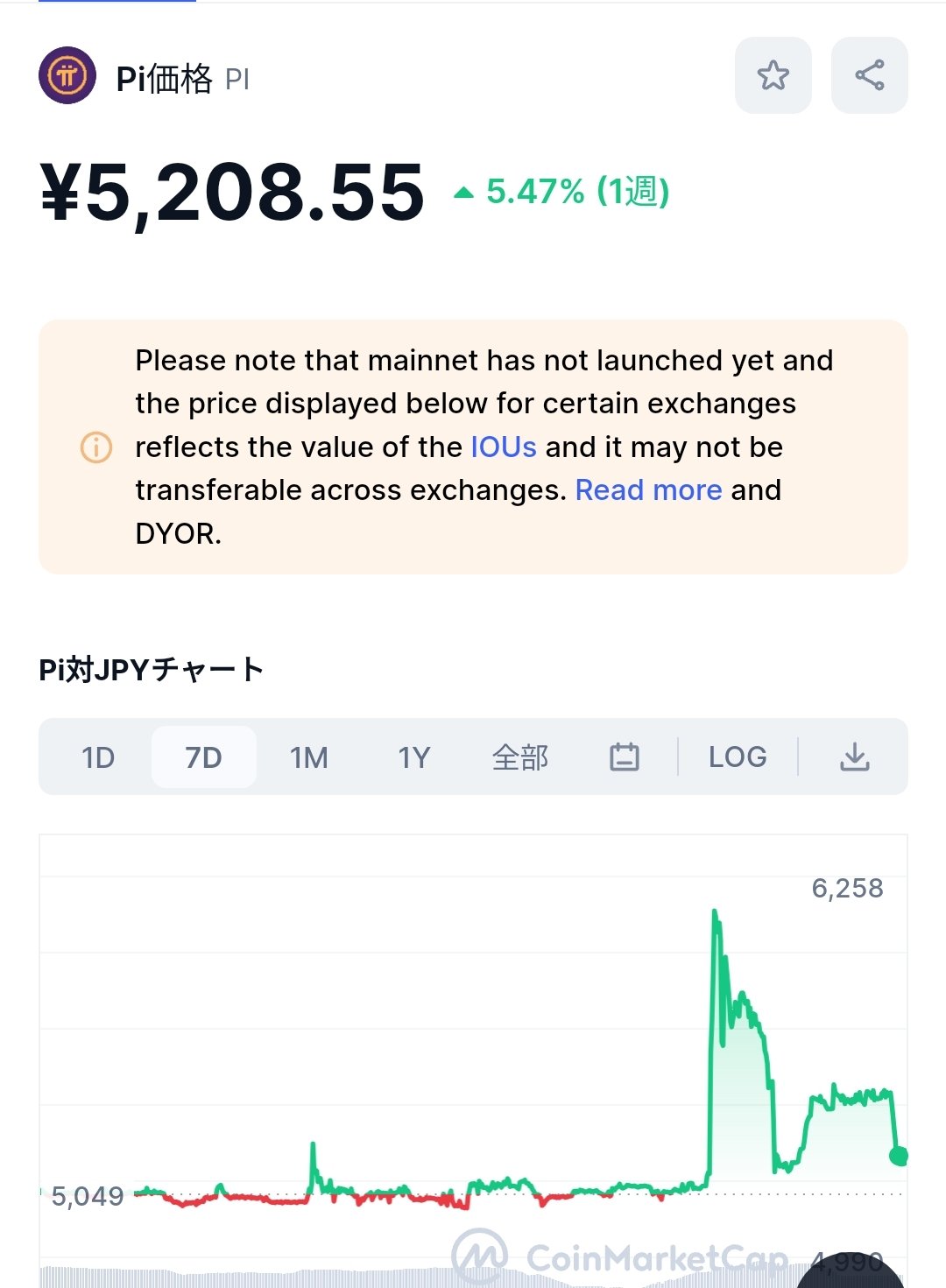
Since Pi is not yet listed on exchanges, there is no official price. However, when it was temporarily listed on FUBT, an exchange in Hong Kong, in March 2022, there were reports that it reached a high of 43,000 yen. This is thought to be due to factors such as Pi’s user base exceeding 30 million people and the approaching launch of the mainnet.

As of December 7, 2023

The mainnet is the production network for cryptocurrency, and when the mainnet is launched, Pi will become a formally tradable cryptocurrency. When the mainnet is launched, the price of Pi may rise further.

Pi is an innovative cryptocurrency that can be mined on a smartphone. Pi aims to lower the barrier to participating in the world of cryptocurrency, allowing more people to enjoy the benefits of cryptocurrency. Since Pi is not yet listed on exchanges, you can mine it for free now. If you are interested in Pi, please download the app.

Source

https://coinmarketcap.com/ja/currencies/pinetwork/

Explanation of Keywords Appearing in the Article

  • Pi: A cryptocurrency project that can be mined on a smartphone. Developed by PhD students at Stanford University.
  • Mining: The process of verifying cryptocurrency transactions and issuing new cryptocurrencies to earn cryptocurrency as a reward.
  • Exchange: A place where cryptocurrencies can be bought and sold. When listed on an exchange, the price of the cryptocurrency is determined.
  • Mainnet: The production network for cryptocurrency. When the mainnet is launched, the cryptocurrency becomes formally tradable.

The Three Founders of Pi Network

Pi Network was developed with the aim of providing an innovative platform for the cryptocurrency industry. Behind it are three PhDs from Stanford University. This article will introduce Dr. Nicolas Kokkalis, Dr. Chengdiao Fan, and Dr. Vincent McPhillip in detail.

Join the Pi Network from the link below. We have explained it in detail!

https://pinetwork.masters-all.com/start/

Dr. Nicolas Kokkalis: Chief Architect

Dr. Nicolas Kokkalis is a PhD in Computer Science and serves as the Chief Architect of Pi Network. He has conducted research in areas such as data mining, artificial intelligence, and social computing at Stanford University. Leveraging this experience, he is building the foundational technology of Pi Network. Under his leadership, the team is working on the development of decentralized applications and blockchain technology.

https://minepi.com/about/dr_nicolas_kokkalis/

Dr. Chengdiao Fan: Product Manager

Dr. Chengdiao Fan is a PhD in Human-Computer Interaction (HCI) and serves as the Product Manager of Pi Network. She has conducted research focusing on usability and system design. Utilizing her expertise, she strives to improve the user experience of Pi Network. She makes important decisions regarding platform design and optimization of the development process.

https://minepi.com/about/dr_chengdiao_fan/

Dr. Vincent McPhillip: Community Manager

Dr. Vincent McPhillip is a PhD in Computer Science and serves as the Community Manager of Pi Network. He has conducted research in fields such as cryptocurrency, blockchain technology, and data mining. His role involves the development and management of the Pi Network user community. He is active in areas such as communication with community members, collecting user feedback, and user support.

Dr. Vincent McPhillip is also involved in strategic planning to expand the Pi Network ecosystem. His goal is to grow the user community and make Pi Network a platform accepted by people worldwide. He is raising the visibility of Pi Network through community-led events, campaigns, and educational programs.

https://pi.xahrj.com/news/361.html

Summary: Contributions of the Pi Network Founders

The founders of Pi Network, Dr. Nicolas Kokkalis, Dr. Chengdiao Fan, and Dr. Vincent McPhillip, have outstanding backgrounds in their respective fields. They launched Pi Network to improve the accessibility of cryptocurrency. Their knowledge and experience have greatly contributed to the development and spread of the platform.

They each hold roles in architecture design, product management, and community management, leading the overall project. Through their teamwork and dedication, Pi Network has grown rapidly and become an innovative cryptocurrency platform supported by users worldwide. They will continue to strive for the further development of Pi Network and its impact on the industry.

Pi Network Developer Team: The Innovative Cryptocurrency Platform They Are Building

Pi Network is an innovative smartphone-based cryptocurrency project. This platform is supported by a team of excellent developers. This article introduces the developers of Pi Network and explains the innovative cryptocurrency platform they are building.

Join the Pi Network from the link below. We have explained it in detail!

https://pinetwork.masters-all.com/start/

1. Developer Team Background

The Pi Network development team was formed around three PhDs from Stanford University. They have high expertise in various fields such as computer science and human-computer interaction (HCI).

  • Dr. Nicolas Kokkalis: PhD in Computer Science and serves as the Chief Architect of Pi Network. He has been involved in research in data mining, artificial intelligence, and social computing.
  • Dr. Chengdiao Fan: PhD in Human-Computer Interaction and serves as the Product Manager of Pi Network. She has conducted research focused on usability and system design.
  • Dr. Vincent McPhillip: PhD in Computer Science and serves as the Community Manager of Pi Network. He has conducted research in fields such as cryptocurrency, blockchain technology, and data mining.

2. What the Developer Team Aims For

The Pi Network development team aims to make cryptocurrency more accessible. They have addressed the problem that current cryptocurrency mining consumes a lot of energy and requires special hardware, and have created a platform that allows easy mining using smartphones.

The development team also values community and is realizing a decentralized ecosystem by building trust among participants. They listen to user feedback and strive to improve features and solve problems, providing an environment where all participants can contribute to the development of Pi Network.

3. Developer Team Initiatives

The Pi Network development team is undertaking various initiatives to advance the project. The main initiatives are as follows:

  • App Updates: Regular app updates are performed to improve user experience and optimize performance.
  • Partnerships: Partnerships are formed with various companies and organizations to promote the spread of Pi Network and expand the ecosystem.
  • Communication: The development team values communication with users and exchanges opinions and provides information through chat rooms and forums.

4. Future Outlook of the Developer Team

The Pi Network development team is expected to continue undertaking various initiatives for the project’s development in the future. Specifically, the following developments are possible:

  • Mainnet Launch: Pi Network is currently in the Testnet phase, but development will proceed towards the Mainnet launch in the future.
  • Expansion of Use Cases: Increasing the use cases of Pi tokens will make it easier for more people to participate in the Pi Network ecosystem.
  • Technological Evolution: The development team will quickly respond to the latest trends in blockchain technology and cryptocurrency and further evolve the project.

Summary: Pi Network Developer Team and the Innovative Cryptocurrency Platform

Pi Network is being developed by PhDs from Stanford University, and their expertise and passion are greatly contributing to the project’s success. The development team aims to improve cryptocurrency accessibility and provide an energy-efficient smartphone-based mining platform.

They also adopt a community-focused approach and are realizing a decentralized ecosystem by building trust among participants. The Pi Network development team is expected to continue undertaking various initiatives for the project’s development in the future, aiming for the spread and innovation of cryptocurrency.

Through these initiatives, Pi Network will continue to grow and establish its position as an innovative cryptocurrency platform used by increasingly more people. With the passion and dedication of the development team, Pi Network is expected to open up new possibilities in the cryptocurrency industry.