Pi Node」タグアーカイブ

Pi Network’s Pi Node (Pi Desktop) Explained: Roles, Setup, Selection Criteria, and Future

Recently, the term “decentralization” has gained significant attention alongside the concept of Web3. Pi Network, a smartphone mining app gaining global popularity, is a project striving to realize this decentralized network vision.

In Pi Network’s envisioned decentralized future, the Pi Node (now Pi Desktop) plays a crucial role. Alongside mobile app mining, Pi Nodes serve as the backbone, maintaining network security and integrity.

This article provides a comprehensive explanation of Pi Node (renamed Pi Desktop in the latest Pi Network update), covering its role, participation levels, selection criteria, and future roadmap. Even without specialized knowledge, you’ll gain a deep and accurate understanding.

How will you contribute to Pi Network’s future? Through this article, gain insight into the importance and potential of Pi Nodes and take the next step in your engagement with the Pi Network ecosystem.

What is a Pi Node? Its Role in Supporting the Decentralized Network

A Pi Node is a crucial computer application that validates and records transactions on Pi Network’s decentralized ledger (blockchain). Similar to other blockchains, consensus among all nodes on the transaction order solves the challenges of maintaining a decentralized currency.

Pi Network’s Stellar Consensus Protocol (SCP)

Unlike Bitcoin and Ethereum, which use the energy-intensive “Proof-of-Work (PoW)” consensus algorithm, Pi Nodes utilize the Stellar Consensus Protocol (SCP), a different approach.

SCP involves nodes forming groups of trusted nodes (called “quorum slices”), agreeing only on transactions approved by these trusted nodes. This mechanism works in conjunction with the “security circles” formed by mobile miners, creating Pi Network’s unique global trust graph to determine who can and cannot validate transactions on the shared ledger.

This allows Pi Network to be more environmentally friendly and accessible, avoiding the massive energy consumption of typical PoW systems.

User-Centric Design Philosophy

Unlike many crypto projects, Pi Node prioritizes a “user-centric” design. Instead of requiring deep technical expertise for node setup, it’s designed for ease of participation; users simply install the desktop application on their computer. This approach aims for a truly decentralized ecosystem.

Three Pi Node Participation Levels: Find Your Contribution

The Pi Node software (Pi Desktop) offers three participation levels based on technical involvement. Each level has different roles and requirements, allowing users to contribute according to their capabilities.

1. Pi Desktop (formerly Computer App): Easily Connect with Pi Network

  • Role & Function: This level uses only the desktop app interface of the Pi Node software, providing similar functionality to the Pi Network mobile app on your PC. For example, view your Pi balance on a larger screen, use the chat function, or view media content.
  • Technical Requirements: No special technical knowledge or configuration is needed; it’s as easy as installing a typical PC app.
  • Features & Contribution: Improves accessibility to the Pi Network ecosystem and increases user engagement. However, this level doesn’t provide mining bonuses.

2. Pi Node: Become a Blockchain Validator

  • Role & Function: Access the Pi Node interface and follow instructions to complete necessary technical preparations (e.g., port forwarding). This allows your computer to run blockchain components, validating transaction validity and submitting transactions to be recorded on the blockchain. It doesn’t directly participate in consensus formation.
  • Technical Requirements:
    • Port forwarding
    • Suitable processor and memory (recommended specifications available)
    • Stable, high-speed internet connection
  • Features & Contribution: Contributes to network health and security, promoting Pi Network’s decentralization. Mining bonuses are possible at this level.

3. Pi Super Node: Supporting the Network’s Backbone

  • Role & Function: The most crucial role, forming the backbone of the Pi blockchain. In addition to all Pi Node responsibilities, it’s responsible for forming consensus to write appropriate transactions to the ledger and ensuring other Super Nodes and Nodes receive the latest blockchain state.
  • Technical Requirements: In addition to Pi Node requirements, a constant connection and highly reliable internet connection are necessary.
  • Features & Contribution: Essential for maintaining network stability and decentralization; selected by the core team. Offers the highest potential rewards due to its advanced contribution.

These three participation levels are further compared in the table below:

Participation Level Role & Function Technical Requirements (Main) Features & Contribution
Pi Desktop Use similar functions of the Pi Network mobile app on a PC (chat, balance check, etc.) No special technical knowledge required Easy access to Pi Network
Pi Node Transaction validation, submission, and recording on the decentralized ledger Port forwarding, appropriate PC specifications, stable internet connection Verifies blockchain integrity, contributes to network decentralization
Pi Super Node Pi blockchain backbone. Consensus formation, state synchronization Node requirements plus constant connection, high reliability, excellent internet connection Maintains network stability and decentralization

Security warnings like Microsoft Defender SmartScreen may appear when installing the Pi Node software, a common occurrence with new apps being installed by many users. As Pi Network’s user base grows, these warnings tend to disappear.

Pi Node/Super Node Selection Process and Criteria

To function as a Pi Node or Pi Super Node in Pi Network’s Testnet, download and install the Pi Node software on your computer. Follow the instructions within the Pi Node application, install the necessary technical packages, and keep the software running continuously. There isn’t a separate “application” screen; the process of correctly setting up and stably running the software is considered the application process itself.

The Pi Network core team then selects Nodes and Super Nodes based on the following criteria. Nodes and Super Nodes are evaluated using similar criteria, but the threshold for Nodes is set lower than for Super Nodes.

Selection Criteria

  • Uptime: Online 24/7 as much as possible.
  • Good Internet Connection: Fast and stable internet access.
  • Port Forwarding Capability on Local Router: Configuration enabling external communication.
  • Appropriate Processor and Memory: PC hardware specifications necessary for smooth node operation. At least 250MB of free disk space is recommended, but older PCs may lack sufficient performance.
  • Prior Community Contributions: Active participation in the Pi Network community.
  • Security Circle and Trust Score: Indicators of trustworthiness within Pi Network.
  • KYC (Know Your Customer) Completion: The process verifying the participant is a real person.

Selected Node and Super Node applicants are typically notified through the Pi Node interface over a period of about three months. Pi Network aims to be as inclusive as possible and plans to develop additional ways for more pioneers to access the Node role in the future.

Pi Network Testnet Roadmap: The Path to Decentralization

Pi Network presents a three-stage Testnet roadmap towards building a fully decentralized Mainnet. This roadmap is crucial for ensuring network stability, security, and scalability.

1. Selection Phase

  • Purpose: The core team runs the consensus algorithm on pioneers’ computers who have applied to be Nodes and successfully installed the necessary packages. This allows them to understand individual Node requirements (hardware, uptime, bandwidth, connection stability, etc.) and define appropriate thresholds to balance network security and activity.

2. Revision Stage

  • Purpose: Scenario testing and iterative improvement of the consensus algorithm. Stress tests simulating various scenarios (e.g., half the network is isolated, a Node suddenly stops/is compromised) are conducted to determine algorithm modifications and application methods for ensuring security, improving activity, and achieving scalability.
  • This stage includes a centralized layer to allow the core team to assign simulated data of the network graph and configuration to different Nodes, enabling efficient testing of a wide range of scenarios. This centralized layer will be removed in the Mainnet after serving its testing purpose.

3. Live Testnet

  • Purpose: After the selection and revision stages, various Node types actively fulfill their responsibilities. The network’s performance is tested using real data from security circles generated by mobile miners and the actual activities of network participants. This stage also includes an iterative process of testing, data analysis, debugging, and revision, continuing the pursuit of security, liveness, and scalability.

Through these stages, Pi Network addresses unique challenges (a large number of participants, decentralization of PCs as Nodes, integration of trust graphs from mobile miners, etc.) and advances the adaptation and expansion of SCP tailored to the needs of the Pi blockchain.

Frequently Asked Questions (FAQ) about Pi Node

Q. What’s the relationship between Pi Node software and the Pi Network mobile application?

A. The Node software and the mobile app are not mutually exclusive but complementary. You log in to the Node software using your mobile app account, linking them to the same Pi account. Mobile mining can only be started from the mobile app, but the Node’s Pi Desktop interface allows you to check your balance, chat, and view media content on the home screen.

Q. How does running a Node affect my device? Does it consume CPU or battery power?

A. When using only Pi Desktop (with Node or Super Node functions “off”), CPU, memory, and network traffic consumption is minimal, with little impact on the device. When running with Node or Super Node functions “on,” CPU, memory, hard drive, and network resources are used. Data is being collected during the Testnet period to better determine the specific impact on devices.

Q. Are there rewards for running a Node?

A. One goal of the Pi Testnet is to determine what rewards should be given for running a Node. The core team is gathering relevant data to determine the most appropriate incentive mechanism, but there are currently no direct mining rewards for Testnet Nodes. A reward mechanism based on Node contributions may be introduced in the future.

Q. Is the Pi Node software open source?

A. The blockchain components of the Node are planned to be open-sourced. Currently, the core team is organizing the GitHub repository and aims to maintain an open issue list for community members to contribute as needed.

Conclusion: Accelerate Pi Network’s Future by Running a Pi Node

The latest update to Pi Network’s Pi Node (Pi Desktop) demonstrates the steady progress in the project’s decentralization efforts. Pi Nodes are not just mining tools but essential pillars supporting Pi Network’s security, stability, and decentralization.

With three participation levels—Pi Desktop, Pi Node, and Pi Super Node—users can deeply engage with the Pi Network ecosystem according to their technical skills and willingness to contribute. Participating as a Pi Node or Super Node is crucial for maintaining network health and building the foundation of the future decentralized Web3.

While the project is currently in the Testnet phase and direct rewards for running Nodes are not yet confirmed, from a long-term perspective, the value of running a Node may increase with Pi Network’s growth. Always check the Pi Network official website and in-app notifications for the latest information, as official announcements are constantly updated.

Hopefully, this article has answered your questions about Pi Nodes and deepened your understanding of Pi Network. Let’s participate in building Pi Network’s decentralized ecosystem and create the future together.

Pi Network’s Historic Turning Point: Open-Sourcing the Pi Node Blockchain and its Future Implications

Introduction: Pi Network’s Giant Leap Forward

Pi Network, a novel cryptocurrency allowing for easy mining on smartphones, has garnered significant global attention. The project is steadily expanding its ecosystem towards its ultimate goal: mainnet launch.

Recently, the announcement of “open-sourcing the Pi Node blockchain components” has created significant buzz, marking a pivotal moment in Pi Network’s history. This isn’t merely a technical announcement; it underscores Pi Network’s commitment to building a truly decentralized ecosystem, reflecting its philosophy and vision.

Why is this open-sourcing a historic turning point for Pi Network? How will it impact Pi users (known as Pioneers) and the future Pi Network envisions? This article delves into the rationale behind this significant announcement and its multifaceted impact on Pi Network.

Understanding Pi Nodes in Pi Network and the Significance of Open-Sourcing

The Role of Pi Nodes: Essential Components of Pi Network’s Decentralized Network

Pi Network aims to make cryptocurrency accessible to everyone via smartphones. However, at its core lies the **Pi Node**, software running on PCs. Pi Nodes play a critical role in maintaining the blockchain network. Specifically, they validate transactions, maintain network security, and ensure the consistency of the distributed ledger.

While the smartphone app serves as the interface for Pi mining, Pi Nodes are crucial for establishing Pi Network as a true blockchain-based decentralized network, rather than simply a points system.

The Importance of “Open Source” in Blockchain Technology

“Open source” refers to the practice of making a software’s source code publicly available, allowing anyone to view, modify, distribute, and contribute to its improvement. This contrasts with “closed-source” software, developed and managed exclusively by specific companies or organizations.

Blockchain technology and open source are highly compatible; indeed, open source is crucial for realizing the core value of blockchain. Major blockchain projects like Bitcoin and Ethereum are all open-source. This offers several key advantages:

  • Transparency: Publicly available code allows anyone to verify the absence of malicious activity or hidden functionalities.
  • Security: Global developers audit the code, identifying and fixing vulnerabilities, enhancing the overall system security.
  • Collaborative Development: Utilizing collective intelligence accelerates development, enabling the addition of more innovative features.

Pi Network’s decision to open-source the Pi Node blockchain components is a strategic and philosophical move, aligning the project with the ideal blockchain model and ensuring its long-term reliability and growth.

A Historic Turning Point: Five Transformations Brought About by Pi Node Open-Sourcing

Open-sourcing Pi Nodes is expected to bring numerous positive changes to Pi Network. Here are five key transformations and how they will contribute to its future:

1. Absolute Transparency: From Black Box to Foundation of Trust

What to Learn: The significance of fully disclosing Pi Node’s operational principles.
What to Understand: How this improves Pi Network’s credibility and eliminates doubts.

Previously, some users perceived Pi Network’s inner workings as a “black box.” However, open-sourcing the Pi Node blockchain components makes the source code fully public. This allows developers, experts, and even ordinary users worldwide to examine how Pi Nodes operate and validate transactions.

This absolute transparency will significantly enhance trust in Pi Network by eliminating doubts about fairness and security. By making its core technology transparent, like disclosing a company’s financial status, users can participate with greater confidence. This embodies blockchain’s core value: decentralized trust.

2. The Power of a Global Community: Collaborative Development Accelerates the Project

What to Learn: The potential for global developers to participate in Pi Network’s development.
What to Understand: How Pi Network evolves as a community-driven project.

One of open-sourcing’s most significant advantages is attracting global developers. Instead of relying solely on the Core Team, thousands of programmers and engineers can review Pi Node’s code, submit improvement suggestions (pull requests), and contribute to bug detection and fixing.

This mirrors the success of open-source projects like Linux and Ethereum, which have evolved remarkably through community collaboration. Leveraging collective intelligence, Pi Network can achieve faster, higher-quality development as a “community-by, community-for project,” adapting to diverse needs.

3. Accelerated Technological Innovation: Evolution of Algorithms and Systems

What to Learn: How open-sourcing fosters technological breakthroughs.
What to Understand: How Pi Network’s technological competitiveness is strengthened.

With many brilliant minds accessing the Pi Node source code, algorithm optimization and improved system processing efficiency are expected to accelerate. This could lead to technological breakthroughs such as faster transaction processing, more efficient node operation, and compatibility with diverse devices and operating systems.

This will be a crucial driver for Pi Network to stay at the forefront of technology, preventing obsolescence. In competing with other blockchain projects, this speed and flexibility of technological innovation will be a significant competitive advantage.

4. Robust Security: Multifaceted Monitoring for Vulnerability Detection

What to Learn: How community code monitoring enhances security.
What to Understand: Why the Pi Network ecosystem becomes safer and more stable.

Closed development environments may overlook software vulnerabilities and bugs. However, with Pi Node open-sourced and its code constantly checked by hundreds or thousands of individuals, potential security risks can be identified and rectified quickly.

This aligns with the “Linus’s Law” in the open-source community—”Given enough eyeballs, all bugs are shallow.” In the blockchain world, where cybersecurity threats are constant, this multifaceted monitoring system will significantly enhance Pi Network’s security, creating a safer, more stable ecosystem for users.

5. Towards True Decentralization: Moving Away from Centralization and a User-Driven Future

What to Learn: How open-sourcing is essential for realizing a decentralized network.
What to Understand: Pi Network’s ultimate goal: a user-centric blockchain.

Blockchain’s core principle is “decentralization.” Pi Node’s open-sourcing reduces reliance on the Core Team, enabling community node operators (Pioneers) to form the network’s backbone.

With everyone able to verify the code and operate nodes, network maintenance and management won’t be concentrated in a few groups. This facilitates a truly decentralized state. This is a crucial step towards Pi Network evolving into a “project by millions” and fulfilling its vision of “bringing blockchain to everyone.”

Pi Network’s Core Team is preparing a GitHub repository for this open-sourcing initiative, publishing a list of unresolved issues and encouraging community contributions. This goes beyond a technical announcement; it embodies Pi Network’s ambitious vision as a social project aiming for societal transformation, shaping the future of decentralized finance.

Conclusion: Pi Network Enters a New Phase; Your Participation Shapes the Future

Open-sourcing Pi Node’s blockchain components is a landmark step towards project maturity and achieving a truly decentralized ecosystem. This move brings absolute transparency to Pi Network, invigorates global community collaboration, accelerates technological innovation and security, and most importantly, paves the way for true decentralization.

Pi Network’s future depends not only on the Core Team’s efforts but also on the participation and contributions of each Pioneer. Understanding this historic turning point and continuing to participate in Pi Network’s ecosystem will help shape the future of digital currency and Web3.

Regularly check Pi Network’s official announcements and GitHub repository for updates. Join Pi Network in this new phase and contribute your intellectual curiosity and action to building the future.

Pi Node Latest Version v0.5.1: Mainnet Migration and the Importance of Operation

The Pi Network is scheduled to transition to the “Mainnet” on February 20, 2025, a development that will significantly expand the decentralized ecosystem. Within this, Pi Node operators play a core role in the network, being crucial entities that support stability and reliability.

Latest Update “v0.5.1” and Pi Nodes

Version “v0.5.1”, released on February 14, 2025, is a very important update for Pi Node operators. In this version, the system is automatically updated, and the PC is restarted, ensuring that the latest state is maintained. This guarantees smooth operation during the Mainnet transition.

There seem to be Maintenance Rate and Selection Criteria

According to information, for a Pi Node to be selected for the Mainnet, the “Maintenance Rate” is a crucial indicator. This rate is calculated based on the operational status over the past 90 days, and accounts that maintain a high operational rate are prioritized for selection.

High-Quality Hardware is Advantageous

It is advantageous for Pi Node operators to run on high-performance and reliable hardware. This provides the following benefits:

  • Stable Operation: System errors can be minimized even during long periods of continuous operation.
  • Improved Reward Points: Maintaining high performance is advantageous when calculating rewards.
  • Long-Term Cost Reduction: Durable equipment does not require frequent replacement or repair.

Pi Node Operation and Ecosystem Expansion

After the Mainnet transition, Pi Nodes will function as the core of the decentralized ecosystem. Specifically:

  • Transaction Validation: Validates transactions performed on the Pi blockchain, ensuring security and transparency.
  • dApps Support: Supports the foundation of over 100 decentralized applications (dApps) operating on the Pi Network.
  • Network Expansion: Provides an environment that makes it easy for new users and developers to participate.

Collaboration with dApps

dApps (decentralized applications) play an important role in the growth of the Pi ecosystem. For example, on platforms like “1Pi Mall” and “Workforce Pool”, users can utilize Pi for actual product purchases and service usage. These applications cannot exist without the stable foundation provided by Pi Nodes.

Future Outlook

This Mainnet transition is a major milestone for the entire Pi Network. Pi Node operators, in particular, are key to the success of this project. With high-quality hardware and continuous maintenance of operational rates, greater rewards and contributions to ecosystem expansion are expected.

Call to the Community

Even if you haven’t started operating a Pi Node yet, please consider participating at this opportunity. Even with an old PC you have lying around, you may be able to earn node bonuses through continuous effort.

Summary

Operating a Pi Node is not just a technical task, but also a contribution to a decentralized future society. Let’s utilize the latest update “v0.5.1” and aim for efficient and stable operation with high-quality hardware. And let’s continue to support this innovative project even after the Mainnet transition on February 20, 2025.

Pi Node 0.5.0 Automatic Update: Latest Information and Points to Note

1. Latest Trends in Pi Network

Pi Network is an innovative blockchain project that allows users to mine cryptocurrency using mobile devices, which started in 2019. Currently, Pi Network is progressing towards migrating to the open mainnet, and significant updates are being made as part of the preparation phase.

1.1 Importance of Pi Node

Pi Node plays an essential role in maintaining the Pi blockchain network and processing transactions. In particular, users operating Pi Nodes are expected to play a significant role on the open mainnet.

2. Overview of Pi Node 0.5.0

On October 17, 2024, Pi Network migrated to Testnet 2 and released a new version of Pi Node, 0.5.0. This version is a significant update in preparation for the migration from the testnet to the mainnet.

2.1 Key Changes in Version 0.5.0

  • Migration to Testnet 2
  • Support for the latest blockchain technology
  • Increased transaction processing speed and improved stability
  • Improved connectivity between nodes
  • Improved error logging

2.2 What is Testnet 2?

Testnet 2 is an intermediate stage to further develop Pi Network’s blockchain technology and smoothly transition to the mainnet. This new version aims to enhance security and improve node efficiency.

3. Installation and Setup of Pi Node 0.5.0

3.1 Installation Steps

  1. If you have been operating a node, it will be automatically updated.
    Please wait for the automatic update. If you were operating a version older than when the automatic update feature was added, please install the version distributed on the official website.

3.2 How to Connect to Testnet 2

  1. Open Pi Node and select Testnet 2 from “Select Environment”.
    Selecting Testnet 2 is mandatory as Testnet 1 will eventually be discontinued.
  2. Click “Run Testnet 2” to connect to the network
  3. After successful connection, synchronization of the new blockchain will begin

4. Note: Status as a Beta Version

Pi Node 0.5.0 is currently positioned as a beta version. Therefore, caution is required for general users.

4.1 Risks of Beta Version Installation

  • Stability is not guaranteed
  • Unexpected errors or issues may occur
  • Risk of data loss

4.2 Recommended Actions

  • For technically knowledgeable users and developers
  • General users are recommended to continue using the stable version (currently 0.4.11)
  • Waiting for the official release is the best course of action

5. Benefits of Operating a Pi Node

By operating a Pi Node, users not only support the stability of the Pi blockchain but also have the potential to earn future rewards.

  • Special rewards during mainnet migration
  • Long-term profits from the increase in Pi’s value
  • Contribution to blockchain technology

6. Summary

Pi Node 0.5.0 is an important step towards Pi Network’s mainnet migration. However, as it is currently a beta version, it is advisable for general users to continue using the stable version and wait for the official release. Technically knowledgeable users and developers can try the beta version for testing purposes, but they must do so with a full understanding of the risks. The administrator will wait and not install it for now. If I install it, I will report back.

Pi Network’s progress, especially with the release of this latest version, has made the mainnet migration feel increasingly real. Attention is focused on future developments, and operating a Pi Node holds the potential for significant rewards in the future.

It is important to constantly check for the latest information and act according to official announcements. Don’t miss this great opportunity to contribute to the growth of Pi Network.

Pi Node 0.5.0 Automatic Update: Latest Information and Notes

1. Latest Trends in Pi Network

Pi Network is an innovative blockchain project that allows users to mine cryptocurrency using mobile devices, which started in 2019. Currently, Pi Network is progressing towards migrating to the open mainnet, and significant updates are being made as part of this preparation phase.

1.1 Importance of Pi Node

Pi Node plays an essential role in maintaining the Pi blockchain network and processing transactions. In particular, users operating a Pi Node are expected to play a significant role in the open mainnet.

2. Overview of Pi Node 0.5.0

On October 17, 2024, Pi Network transitioned to Testnet 2 and released a new version of Pi Node, 0.5.0. This version is an important update in preparation for the migration from the testnet to the mainnet.

2.1 Key Changes in Version 0.5.0

  • Transition to Testnet 2
  • Support for the latest blockchain technology
  • Faster transaction processing and improved stability
  • Improved connectivity between nodes
  • Improved error logging

2.2 What is Testnet 2?

Testnet 2 is an intermediate stage to further develop Pi Network’s blockchain technology and ensure a smooth transition to the mainnet. This new version aims to enhance security and improve node efficiency.

3. Installing and Setting up Pi Node 0.5.0

3.1 Installation Steps

  1. If you have been operating a node, it will be automatically updated. Please wait for the automatic update. If you were operating a version older than when the automatic update feature was added, please install the version distributed on the official website.

3.2 How to Connect to Testnet 2

  1. Open Pi Node and select Testnet 2 from “Select Environment”. Selecting this is mandatory as Testnet1 will eventually be discontinued.
  2. Click “Run Testnet 2” to connect to the network
  3. After successful connection, synchronization of the new blockchain will begin

4. Note: Status as a Beta Version

Pi Node 0.5.0 is currently positioned as a beta version. Therefore, caution is required for general users.

4.1 Risks of Beta Installation

  • Stability is not guaranteed
  • Unexpected errors or issues may occur
  • There is a risk of data loss

4.2 Recommended Actions

  • For technically knowledgeable users and developers
  • General users are recommended to continue using the stable version (currently 0.4.11)
  • Waiting for the official release is the best course of action

5. Benefits of Operating a Pi Node

By operating a Pi Node, users not only support the stability of the Pi blockchain but also have the potential to earn future rewards.

  • Special rewards during the mainnet migration
  • Long-term profits from the increase in Pi’s value
  • Contribution to blockchain technology

6. Summary

Pi Node 0.5.0 is an important step towards Pi Network’s mainnet migration. However, as it is currently a beta version, general users are advised to continue using the stable version and wait for the official release. Technically knowledgeable users and developers can try the beta version for testing purposes, but must do so with a full understanding of the risks. The administrator will wait and see and will not install it for now. I will report once I have installed it.

The progress of Pi Network, especially with the release of this latest version, makes the mainnet migration feel increasingly real. Attention is focused on future developments, and operating a Pi Node holds the potential for significant rewards in the future.

It is important to constantly check for the latest information and act according to official announcements. Don’t miss this great opportunity to contribute to the growth of Pi Network.

How to Install and Set Up Picheck

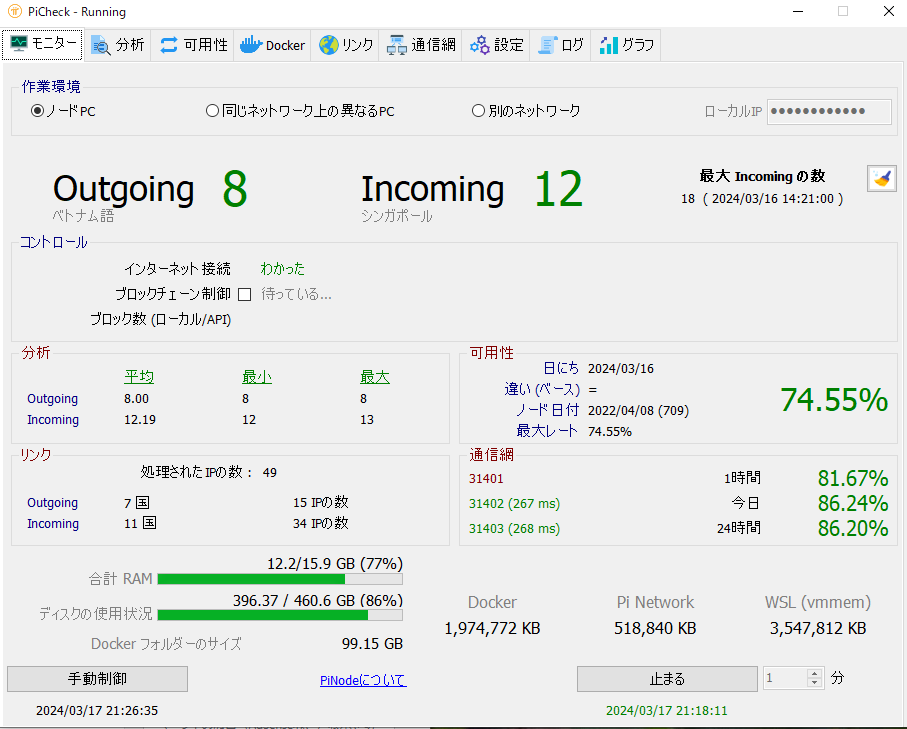
Introducing “Picheck”, a useful auxiliary tool for operating a Pi node.
The purpose of this tool is to display the operational statistics and working environment of your Pi node in real-time.
Like the Pi node, it only needs to be running, so once installed and left alone, it’s a tool that automatically accumulates statistics. It can be operated in Japanese, making it easy to use software.
The administrator was taught about this software in the community and is introducing it after using the tool for half a month.
I believe this is a necessary tool for those aiming for stable Pi node operation.
(Please note that any issues caused by the software are at your own risk.)

This is Picheck compatible with the latest Pi node version.
If you were already using it, you can complete the update by downloading and Japanese localization again following the same steps below.

→ Frequent version updates are performed, and the latest version Ver19 was released on March 1, 2025.

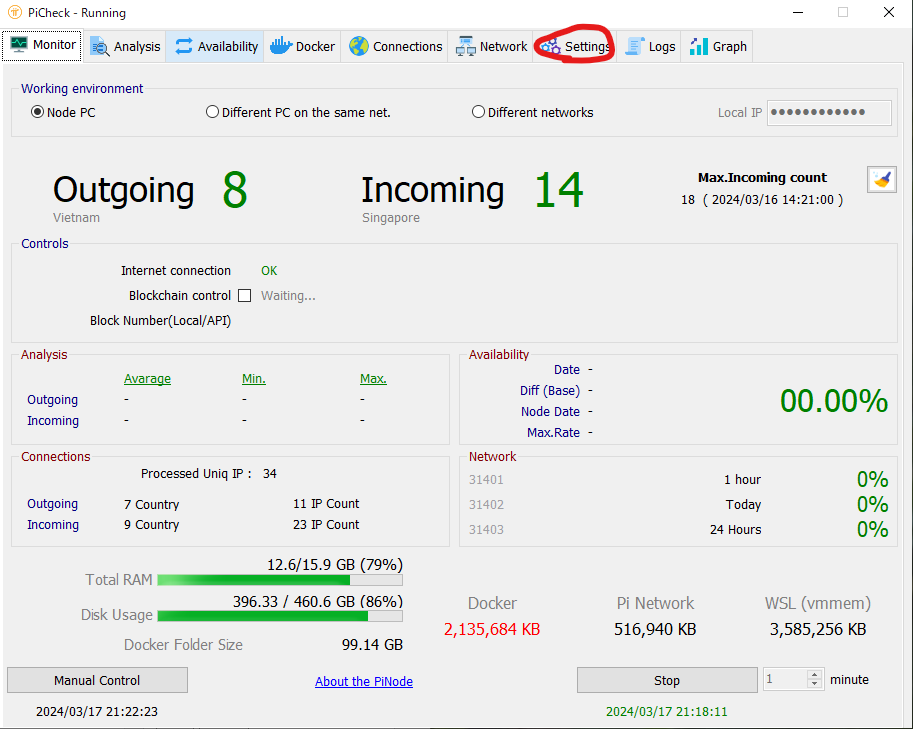
Software Screen

As shown above, basic information such as Outgoing/Incoming, PC load percentage,
RAM and disk capacity, and port forwarding status are displayed in real-time.
You will be able to notice any problems immediately.

Installation Method

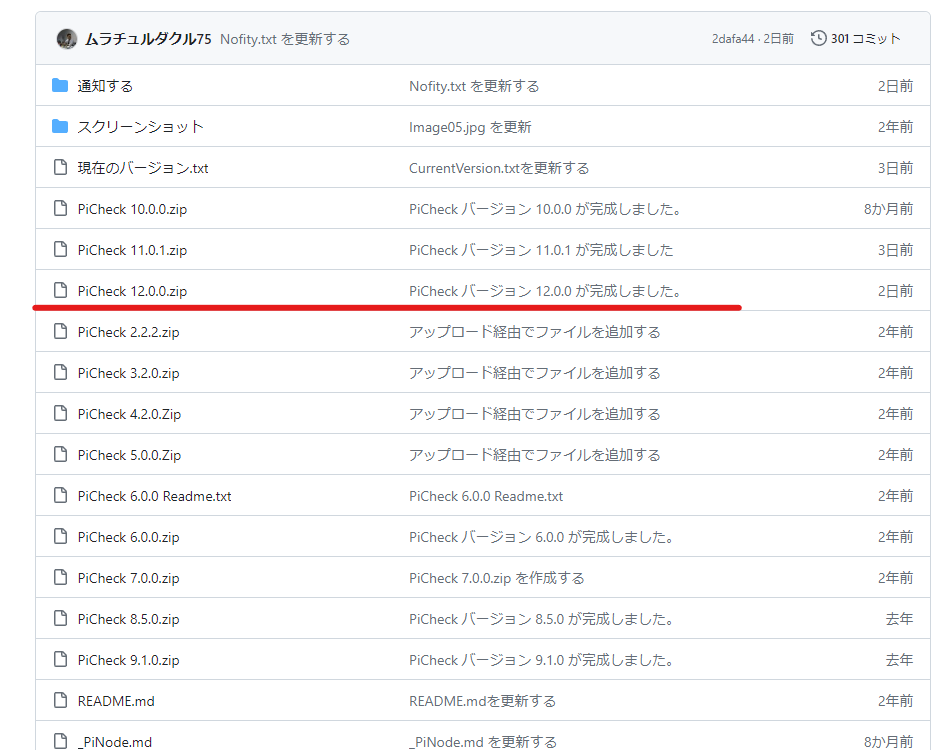
① Access the distribution site
Access github where the tool is distributed.
https://github.com/muratyurdakul75/picheck

② Download the program
Download the latest version of the program.
Click the blue line part of the screen displayed when you access the site below.

Please download the version with the newest date.
Below, 12 was the newest version of the software at that time.

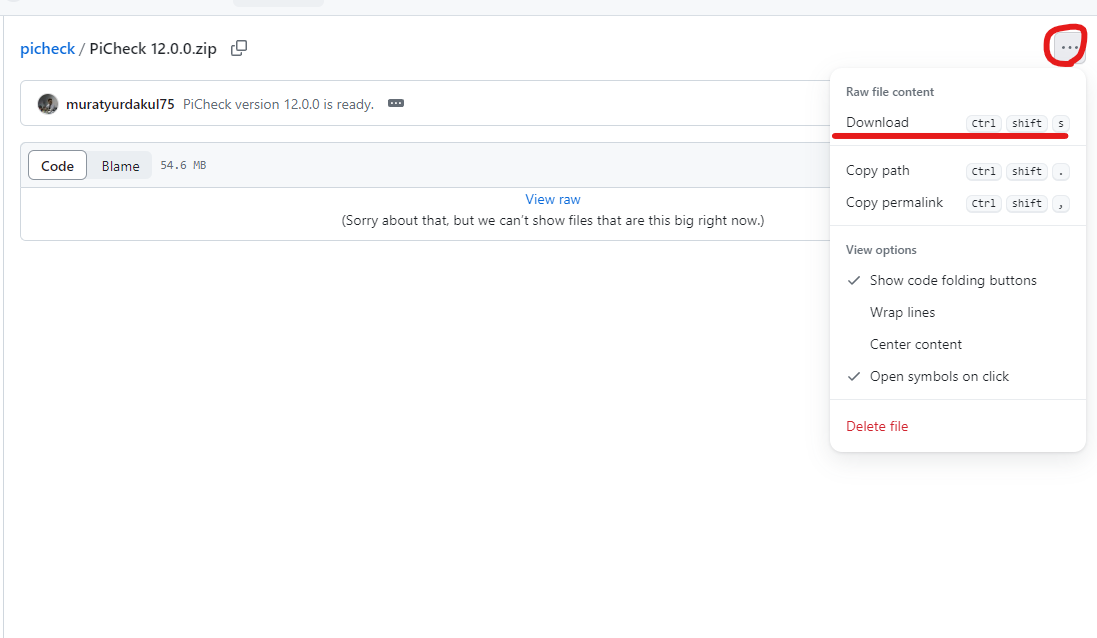
Press the red circle part below to download the program.
(Clicking will start the download automatically.)
As of the time of writing the article, the latest version is 12.0.

③ Extract the program
When the download is finished, a zip file will be saved.
Please extract that zip file to any location.
No installation or other operations are required.
After extracting, open the folder and launch Picheck.exe.

④ Perform initial setup
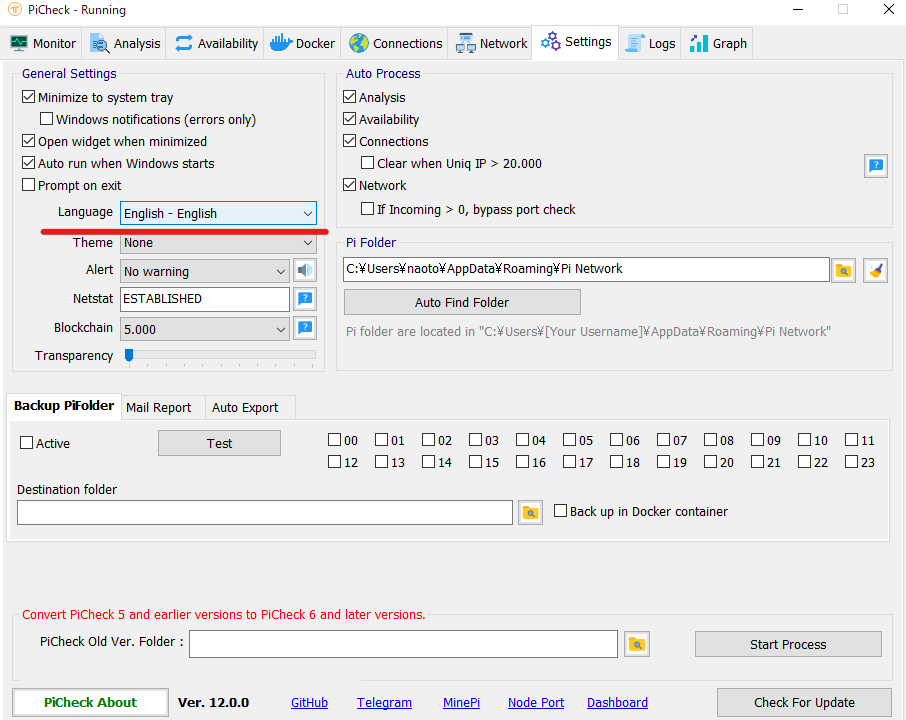
It will start in English initially, so change the setting to Japanese.
(If you can read English, it’s fine as is.)

Initial startup screen
Initially, no statistics are collected, so all values are 0.
Click Setting displayed at the top of the screen.

When the screen changes, click Language in the blue section below.
Select 日本ーJapanese. It will be immediately reflected and displayed in Japanese.
Also, clicking Check for Updates in the bottom right seems to check for the latest version and update it.

Once the initial setup is complete, statistics will be automatically collected.
It’s convenient because the app doesn’t close even if you press the ✗ button.

Others
When I opened the Pi node operation ranking by country, Japan had somehow become 2nd.
I hope they continue this trend and aim for 1st place in the ranking.

(As of March 17, 2024)

(As of 2023/6/11)

You can view the ranking here.
https://dashboard.pi-blockchain.net/

Keywords appearing in the article and their explanations

  • Cryptocurrency: Electronic currency traded on the internet. Bitcoin and Ethereum are famous examples.
  • Mining: The process of adding new blocks to the blockchain of a cryptocurrency. If mining is successful, you receive cryptocurrency as a reward.
  • Blockchain: A decentralized database that records the transaction history of a cryptocurrency. The blockchain is designed to be difficult to tamper with or forge.
  • Pinetwork: A cryptocurrency that can be easily mined on a smartphone. It was developed by PhD students at Stanford University.
  • Pi: The unit of cryptocurrency for Pinetwork. It is scheduled to be listed on exchanges in the future.
  • Pi Node: Connecting your PC to the network to support the Pinetwork blockchain by generating and verifying blocks. Becoming a Pi node has benefits such as increasing Pi mining speed and contributing to the network’s security and decentralization.

How to Update Docker to the Latest Version

If you are operating a Pi Node and cannot keep the block status up-to-date or it is not running stably, it is recommended to update Docker to the latest version.

In my environment, I initially operated with version 4.71, but after experiencing synchronization delays several times a day and obtaining information that a newer version was available, I updated it and was able to achieve stable operation.

Currently, even without any operation for 24 hours, it is always synchronizing the latest blocks.

I believe there is no need to force an update if it is running stably, but if you are concerned about security or feel uneasy without the latest version, updating is a good idea. Also, since node operation will be interrupted during the update, if you are concerned, it is recommended to do it after completing today’s mining. Although it was running stably, I will update Docker for the sake of this article.

In the procedure below, I performed the Docker update while the Pi Node was still running.
The correct procedure might be to stop it before updating.

How to Update Docker

Open the Docker screen.
Click the gear icon displayed in the upper right corner.
If the gear icon has an exclamation mark, it is one indicator that an update is available.

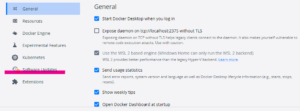
The screen will switch and a menu will be displayed.

Click “Software Updates” on the left side.

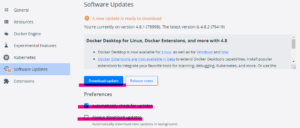
The update details will be displayed in English.
The current version, the latest version number, and the update details are displayed.
In the image below,
Current version 4.8.1(78998)
Latest version   4.8.2(79419)
It is shown as.

If there are no issues, click “Download update”.
The checkbox below is for,

Automatically check for updates
↑ Automatically check for the latest version

Always download updates
↑ Automatically update to the latest version

Only the top one is checked.
I haven’t checked the bottom one because I would be troubled if the node stopped or became unstable due to an update, so I want to update at an arbitrary timing after confirming that the version is stable.

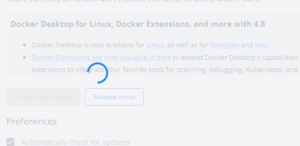
After pressing the download button, the display changes as shown below.
Downloading software.

After the download (around 1 minute) is finished, the display changes to the following.

Pressing this button starts the update process.

The screen turns white…

A screen asking for program changes is displayed, so
Click the “Yes” button.

The update process starts automatically.
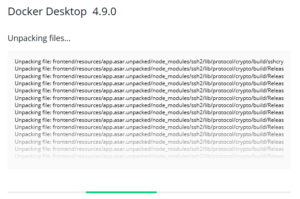
The version displayed after the update earlier was 4.8.2, but it seems the update content was 4.9.0. (Mystery)

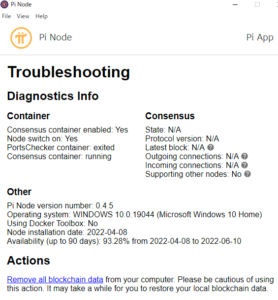
Naturally, the Pi Node stops.
Both Out and In become N/A.

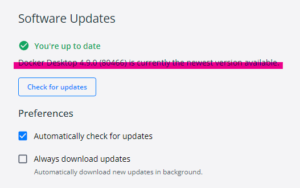
After the update is finished, Docker will automatically restart. When the HOME screen is displayed, the update process is complete. If you click the gear icon again and display the Software Updates screen,
The display has changed like this.

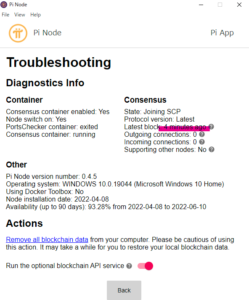
After the update was finished, the Pi Node automatically started operating normally.
Looking at the troubleshooting log, it seems the node was stopped for 4 minutes.

This concludes the Docker update process.
Looking back now, I think I should have stopped the Pi Node when updating Docker. I apologize if this was not the correct procedure.