“Pi Network, which is gaining attention worldwide as a way to easily mine on your smartphone. Are you also wondering, ‘What is the current price of Pi Coin, after all?’ or ‘Will it really gain value in the future?’ and are curious about its movements? This article provides a thorough explanation, easy for those without specialized knowledge, of the latest information regarding Pi Network’s ‘price’ as of 2025, how to peek into its ecosystem using Pi Browser, and the future value Pi Network aims for. Let’s explore the present and potential of Pi Network together!”
Pi Network’s Current “Price” Status: 3 Basic Things You Should Know First
Before looking at specific price information for Pi Coin, let’s cover the basic points about what stage Pi Network is currently in and how you should think about “price.” Understanding this is the first step to correctly interpreting information about Pi Network.
1. It’s Currently the “Enclosed Mainnet” Period – What Does That Mean?
Pi Network is currently in a phase called the “Enclosed Mainnet.” This means that while the Pi Network blockchain is operational, free connection with external blockchain networks and general cryptocurrency exchanges is intentionally restricted. You could compare it to a new city under construction, where entry is still restricted to those involved.
The main objectives of this period are as follows:
- Promoting KYC (Know Your Customer) and preparing for the migration of mined Pi to the Mainnet: To verify that many users are genuine individuals, prevent fraud, and enable the safe transfer of previously mined Pi to Mainnet wallets.
- Building and testing utilities (practical apps and services) within the Pi Network ecosystem: Developers are building various applications (DApps) on the Pi blockchain to increase the places where Pi Coin can actually be used.
- Ensuring network stability and security: Thoroughly testing the overall system operation and fixing issues before full open access.
This Enclosed Mainnet period is positioned as an important preparatory phase for the “Open Mainnet” that Pi Network aims for in the future. As of May 2025, Pi Network is still in this Enclosed Mainnet period and has not transitioned to the Open Mainnet.
2. Pi Coin Does Not Yet Have an “Official Price” – What Are the Prices You See?
Because it is in the “Enclosed Mainnet” period, as of now (May 2025), Pi Coin does not have an “official price” widely agreed upon in the market, like Bitcoin or Ethereum. If you see information online stating “1 Pi Coin = $〇〇,” it is highly likely to be one of the following:
- IOU (I Owe You) type trading prices on some unofficial exchanges: This involves buying and selling the right to exchange Pi Coin when it becomes actually tradable in the future. It is not officially recognized by the Pi Network team. Price fluctuations are volatile, and the risk is high.
- “Reference prices” within specific marketplaces or apps in the Pi Network ecosystem: On some platforms accessible within the Pi Browser (discussed later), prices for goods and services may be listed in Pi Coin. However, these are merely experimental attempts within those platforms or based on local agreements between operators and participants, and do not represent the official value of the entire Pi Network.
- Wishful thinking or target prices within the community (e.g., GCV): Some community members may propose specific prices as a wish or goal (“we want it to be worth this much”), but this is also different from an objective market price.
It is important to understand that these prices do not guarantee the actual value of Pi Network. True price formation is expected to begin in the future, after transitioning to the Open Mainnet and becoming freely tradable on many exchanges.
3. The Importance of KYC (Know Your Customer) – Why Is It Necessary?
In Pi Network, the KYC (Know Your Customer) process is highly emphasized. This is to verify that users are real individuals and are adhering to the principle of one account per person. Why is KYC so important?
- Exclusion of fraudulent accounts and improvement of network reliability: Prevents unfair mining by bots or multiple accounts, enhancing the fairness and reliability of the entire Pi Network.
- Compliance with laws and security assurance: In many countries and regions, KYC is legally required for financial services and cryptocurrency transactions, also serving the purpose of preventing fraudulent activities like money laundering.
- Prerequisite for Pi migration to Mainnet: In principle, users must complete KYC to transfer the Pi Coin they have accumulated in the mining app to their usable wallet on the Mainnet.
While it might feel like a hassle, KYC is a crucial step for Pi Network to build a healthy ecosystem and for Pi Coin to become a trusted currency in the real world in the future.
What is Pi Browser? The Gateway to the Pi Network Ecosystem
To actually experience the world of Pi Network and explore its potential, the dedicated app called “Pi Browser” is essential. This is a mobile browser provided separately from the main Pi Network app, serving as a “gateway” to access various Pi services and applications (DApps) under development. Here, we will guide you through the basic role of Pi Browser and how to access information within the ecosystem, in a way that is easy for beginners to understand.
Let’s Install Pi Browser (Simple Steps)
Using Pi Browser is easy.
- First, open the Pi Network mining app on your smartphone.
- From the app’s menu (usually the three-line icon in the top left, etc.), select “Pi Browser” or a similar item.
- Follow the on-screen instructions to install the Pi Browser app from your smartphone’s app store (Google Play Store or Apple App Store).
- After installation, launch Pi Browser again from the Pi Network mining app, and it will automatically link with your Pi account.
Now you are ready to explore the Pi Network ecosystem!
What Can You Do with Pi Browser? The Expanding World of Pi Network
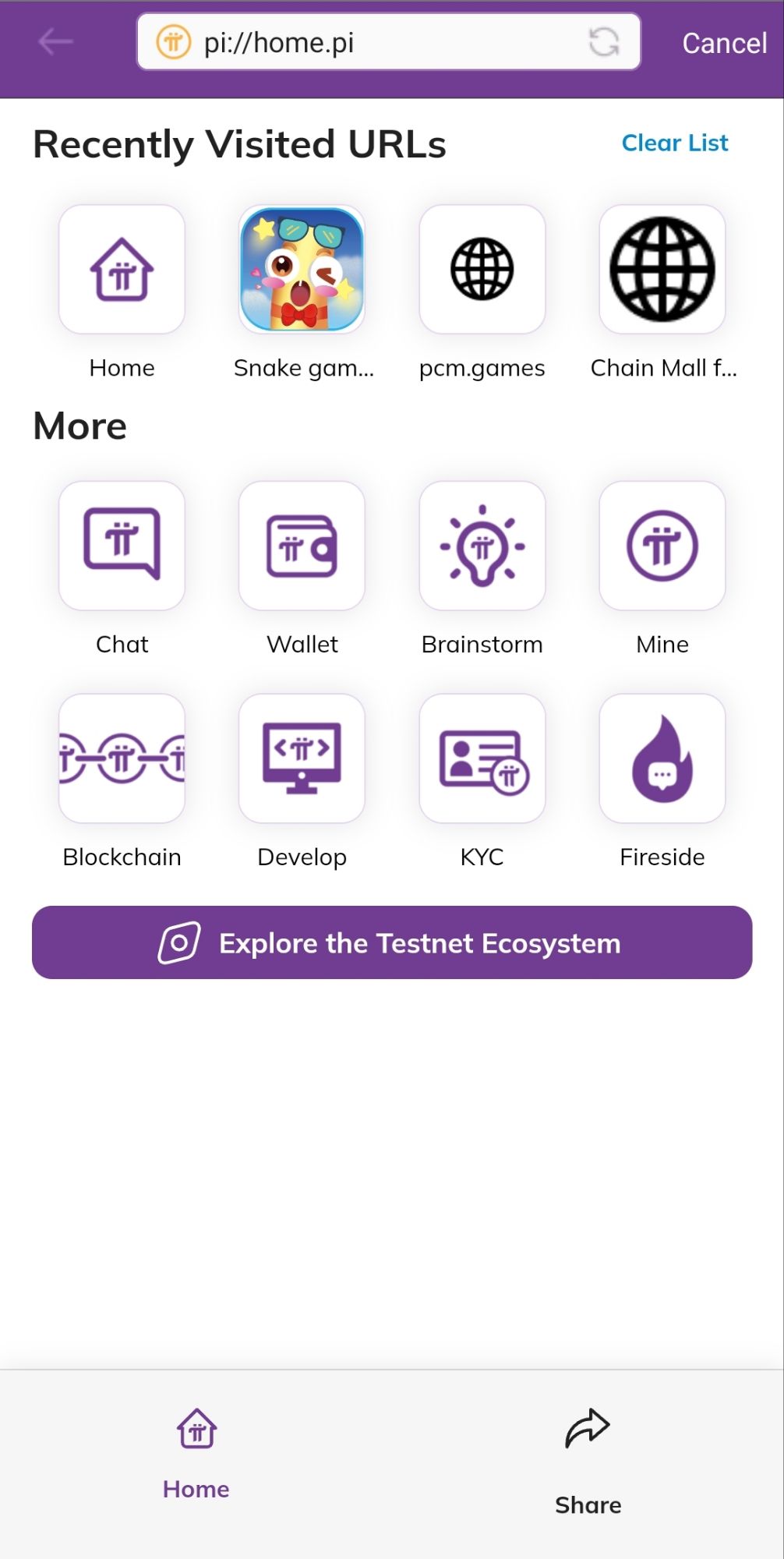
When you launch Pi Browser, several initial icons may be displayed, or you can enter URLs to access various websites. Specifically related to Pi Network, you can do the following with Pi Browser:
- Access your Pi Wallet: You can access the wallet function to manage your Pi Coin. You can check your balance and send/receive Pi Coin to/from other Pioneers (Pi Network users) (after completing KYC and migrating Pi to Mainnet).
- Use DApps (Decentralized Applications) within the Pi Network ecosystem: You can try out various applications being developed on the Pi Network blockchain. This includes marketplaces, games, social media, developer tools, and more.
- Check for the latest information: Official announcements from the Pi Network Core Team and information about the ecosystem may also be provided through Pi Browser.
- Participate in development (for developers): If you are an app developer, you can also access tools and information to develop and test DApps that run on the Pi platform.
Pi Browser is a manifestation of Pi Network’s intention to build an “economic zone (ecosystem)” where Pi Coin is actually used, rather than just being a mining app.
Explore with Pi Browser! The Reality of Marketplaces and “Reference Prices” within the Ecosystem
Now, let’s use Pi Browser to see how Pi Coin is handled within the Pi Network ecosystem, looking at examples of some places referred to as marketplaces and the “reference prices” seen there. Again, please note that the prices introduced here are merely those independently presented by each platform and do not represent the official value of Pi Network. This information should be viewed as a reference point for imagining the activity of the Pi Network community and the future use cases of Pi Coin.
Caution! The Prices Displayed Are Not the “Overall Market Consensus Price”
On marketplaces and e-commerce-like platforms you might find within Pi Browser, prices may be displayed in Pi Coin, such as “Product A is 〇〇 Pi” or “Service B is △△ Pi.” Seeing this and jumping to the conclusion, “This is the current value of Pi Coin!” is prohibited.
Many of these platforms are:
- Likely projects by independent developers or community groups, not directly operated by the Pi Network Core Team.
- Often still in the testing phase or experimental attempts, and the safety and continuity of transactions are not guaranteed.
- The listed Pi prices are often based on local agreements or wishful thinking among the platform operators and participants, and do not reflect the overall market value of Pi Network.
- Whether transactions are actively taking place and if there is sufficient liquidity varies greatly depending on the platform.
It is important to understand these points and calmly observe the information, viewing it merely as “one of the attempts within the Pi Network ecosystem.”
Case Watch: P Bartermall, Marketplace314159, UP Global Mall, etc. – What is Being Traded? What are the Price Trends?
The source information provided (YouTube video) mentioned platforms like P Bartermall, Marketplace314159 (Mall314159), and UP Global Mall. How actively these platforms are actually operating within Pi Browser, what kinds of goods and services are listed in Pi Coin, and the trends in their pricing can constantly change.
Generally, on such platforms, a wide variety of items may be listed, including daily necessities, digital content, services, or even just test listings. Pricing can also vary greatly, from very inexpensive items to those that, when converted to real fiat currency value, seem unrealistically high. This can be seen as a reflection of the fact that the value of Pi Coin is not yet established.
When using these platforms, please be aware of the following points:
- Reliability of the operator: Check who is operating it and if there is any official connection with Pi Network.
- Transaction safety: Be cautious when entering personal information or wallet details, and be careful not to get involved in fraudulent transactions.
- Price appropriateness: Calmly judge whether the listed Pi price is significantly different from general market values.
These platforms can be seen as a reflection of the community’s enthusiasm in exploring ways to use Pi Coin, but it is important to understand that they are not yet established markets at this point.
What is GCV (Global Consensus Value)? The Truth and Reality of the 1 Pi = $314,159 Rumor
Within the Pi Network community, especially among enthusiastic supporters, the term GCV (Global Consensus Value) is frequently discussed. Among these, a specific numerical value of “1 Pi = $314,159” is sometimes spoken of as the GCV. This is a symbolic price setting based on the value of Pi (π ≈ 3.14159), and it has spread among some users as a movement or wish that “Pi Coin should have this much value in the future” or “Let’s form a consensus to trade Pi at this price.”
However, there are important points to understand about this GCV:
- It is not a price set by Pi Network official: GCV is not a price officially announced or guaranteed by the Pi Network Core Team. It is merely a concept led by a part of the community.
- It differs from the principles of market economics: Normally, the price of an asset is determined by the balance of supply and demand in the market. Even if a specific community unilaterally sets a price, if it is not accepted by the market as a whole, a discrepancy will arise from the actual trading price.
- Its realization is unknown: For 1 Pi to be worth approximately $310,000, Pi Network would need to have an economic scale and practicality far exceeding the world’s major currencies and giant IT companies today. This is a very ambitious goal, and objectively evaluating its feasibility at this point is difficult.
GCV reflects the enthusiasm and dreams of people who believe in the potential of Pi Network, and it may have the aspect of strengthening community cohesion. However, it is important to calmly recognize it not as a definitive future value of Pi Coin, but merely as “one goal” or “a movement within the community.” Be careful not to confuse facts with desires.
Why is Price Information So Disparate? Hints to Understanding the Current Situation
As we have seen so far, information regarding the “price” of Pi Coin is very diverse and can sometimes feel contradictory. Why is this situation the case? Several reasons can be considered.
- The project is still under development: Pi Network is still in the Enclosed Mainnet period, and full-scale market price formation has not yet begun. Therefore, there is no clear standard price.
- Lack of liquidity: Because the official market where Pi Coin can be freely bought and sold is limited, there is not enough trading volume (liquidity). Even small transactions or individual agreements can make the apparent “price” seem to fluctuate greatly.
- Speculative movements and expectations: Unrealistic prices may be discussed due to the expectations of people hoping for future value increases or by some information disseminators trying to attract attention.
- Diverse opinions within the community: Pi Network has many users worldwide, and each has different ideas and expectations about the value of Pi Coin. Movements like GCV are one example of this.
- Information asymmetry: Accurate information about the project and development progress is not necessarily conveyed equally and timely to all users.
In such a situation, it is important not to take a single piece of information at face value, but to compare multiple sources and carefully check announcements from the official Pi Network website. Be especially wary of sweet talk like “you’ll get rich quick” or “the price is guaranteed.”
What Determines the True Value of Pi Network? The Present and Future of “Utility”
For Pi Coin to be truly recognized as something “valuable” in the future, simply having many people hold it is not enough. It is essential to have a rich existence of concrete “use cases,” or utility, where Pi Coin can actually be used to buy something or use a service. The Pi Network project also regards the construction of this utility as a very important goal. Here, let’s look at the current state of Pi Network’s utility and future prospects.
“Utility” is the Source of Pi Network’s Value
The word “utility” might sound a bit difficult, but simply put, it means “usefulness” or “practicality.” In the world of cryptocurrency, utility refers to how that coin or token can be used in the real world or digital space.
For example:
- Can be used for payment at stores
- Can be used as payment for specific online services (games, social media, storage, etc.)
- Required for executing smart contracts
- Functions as participation rights or voting rights in a specific community
These are examples of utility. What Pi Network aims for is for Pi Coin to have such diverse use cases and become something that many people find “convenient to hold” or “want to use.” It is believed that the more utility is enhanced, the higher the demand for Pi Coin will become, which could potentially lead to value stability or increase as a result.
What Use Cases Exist Now? Examples of Notable Pi Network Apps and Services
The Pi Network ecosystem is still under development, but among the DApps accessible through Pi Browser, some are showing the beginnings of utility. The following are examples of utility sometimes mentioned in the Pi Network community or official information (however, not all of these apps and services are completed and widely practical).
- Map of Pi: An app aiming to connect local stores and service providers with Pioneers (Pi users) and promote local transactions using Pi Coin.
- Game platforms: Development is underway for game apps where Pi Coin can be used as in-game currency or where players can earn Pi by playing. (The source information mentioned “fruit,” but it is unclear if this is a specific game name or category.)
- Marketplace DApps: The aforementioned P Bartermall and others can be said to be attempts aiming to be platforms where goods and services can be bought and sold with Pi Coin.
- Developer tools and services: Tools and platforms that support DApp development on the Pi Network are also part of the utility.
- In addition, various ideas such as social media, content sharing platforms, job matching services, etc., are being proposed by the community and development is progressing.
The Pi Network Core Team regularly holds hackathons (development contests) and encourages the creation of utility by the developer community. What kind of practical and attractive DApps appear in the future will be very important in predicting the future of Pi Network.
Ecosystem Expansion is Key! The Role of the Developer Community
To increase the utility of Pi Network and enrich the entire ecosystem, the efforts of the Pi Network Core Team alone have limitations. This is where the global developer community plays a crucial role.
Pi Network aims to provide an environment where developers can freely create new applications and services using Pi’s blockchain technology and platform. This is expected to allow diverse ideas that the Core Team alone might not conceive to take shape, and for the ecosystem to grow organically.
Recently, there have been moves to partially relax the pre-approval process for developers publishing DApps on the Pi Network Mainnet, promoting more open and rapid innovation. The more active and talented the developer community grows, the more attractive the Pi Network ecosystem will become, and the utility of Pi Coin will also improve.
We, as general users, can also indirectly contribute to the development of the ecosystem by trying out new DApps through Pi Browser and providing constructive feedback.
Future Price and Potential of Pi Network: The Goal is Open Mainnet Migration, But What is the Current Situation?
Now, let’s discuss the future price and potential of Pi Network, which is likely what many people are most interested in. A major milestone for the project is the transition to the “Open Mainnet,” which is set as a future goal. However, as of May 2025, Pi Network is still in the “Enclosed Mainnet” phase and has not transitioned to the Open Mainnet. It is important to correctly understand this current situation before looking at future prospects.
What Will Change if “Open Mainnet Migration” is Achieved (Future Outlook)
Assuming that Pi Network transitions to the “Open Mainnet” in the future, the following changes can be expected. Please note that this is merely a future possibility and not the current situation.
- Connectivity with external blockchains: The Pi Network blockchain may become capable of interacting and collaborating with other major blockchain networks like Bitcoin and Ethereum.
- Possibility of listing on major cryptocurrency exchanges: If this is realized, Pi Coin could be freely bought and sold on a public market with more participants, potentially leading to price formation based on market principles.
- Further expansion of the Pi Network ecosystem: External developers and companies may find it easier to freely deploy services and businesses on the Pi Network platform.
Conditions for Open Mainnet Migration and the Current Situation
The Pi Network Core Team has outlined several specific conditions for transitioning to the Open Mainnet. It is believed that the Enclosed Mainnet period will continue until these are met. The main conditions are as follows:
- Large-scale completion of the KYC (Know Your Customer) process and migration of Pi to the Mainnet.
- Building and maturation of diverse apps with true utility within the Pi Network ecosystem.
- External environment (market conditions, regulations, etc.) being favorable for the transition to Open Mainnet for the project and community.
As of May 2025, there has been no official announcement that these conditions have been fully met, and Pi Network is in the stage of continuing the operation of the Enclosed Mainnet and developing towards achieving these goals. The specific timing for the transition to Open Mainnet is undecided, and we must await an official announcement from the Pi Network Core Team. While there have been various speculations and unofficial information in the past, it is important to accurately recognize that the current situation is Enclosed.
What Will Happen to Pi Coin Price After Migration? (This is Just an Uncertain Future Discussion)
Assuming that Pi Network transitions to the Open Mainnet in the future and Pi Coin becomes tradable on exchanges, no one can say for sure what its price will be at this point. The price is influenced by a great many factors, including market supply and demand, project reliability, the spread of utility, macroeconomic conditions, and more.
Various price predictions exist, but they are merely predictions and are not guaranteed. Especially in the current “Enclosed Mainnet” situation, a market price for Pi Coin has not been formed, and it is impossible to accurately foresee the future price. Please be very careful not to be misled by easy money schemes or information that guarantees “the price will definitely go up.”
Challenges Pi Network Must Overcome to Build Long-Term Value
For Pi Network to not just be a temporary topic but to grow as a project with long-term value, it must overcome several important challenges. This is true both during the Enclosed Mainnet period and as it aims for the Open Mainnet in the future.
- Ensuring technical stability and scalability: Maintaining and developing a robust blockchain system that can support a user base of tens of millions and process numerous transactions quickly and securely.
- Building and popularizing truly practical utility: Creating a wealth of attractive and convenient DApps and services within the ecosystem that many people will want to use daily, and making them widespread.
- Appropriate response to regulations: Regulations regarding cryptocurrency and blockchain technology are constantly changing in each country. For Pi Network to expand globally, it must comply with these regulations and respond appropriately.
- Maintaining and engaging the user community: Maintaining an active and healthy user community and providing incentives for users to actively participate in the Pi Network project.
- Improving project transparency and reliability: Disclosing information regarding development progress and operational policies to the community in a timely and transparent manner to build trust.
Overcoming these challenges one by one will lead to the long-term success of Pi Network and the sustainable value formation of Pi Coin.
Summary: Understand the “Present” of Pi Network and Approach the Future Wisely
This time, we have looked in detail at the situation regarding Pi Network’s price as of 2025, exploring the ecosystem through Pi Browser, and its future potential.
Pi Network is an ongoing project that has attracted the interest of many people with its innovative approach of mining using smartphones and is being developed with a grand vision. It is important to note that as of May 2025, Pi Network is in the “Enclosed Mainnet” period and has not yet transitioned to the Open Mainnet. Therefore, there is no “official price” for Pi Coin, and “reference prices” are being presented within various attempts in the ecosystem.
The transition to “Open Mainnet” is set as a future goal, but its realization depends on several conditions, and the specific timing is undecided. It is important to correctly understand this current situation and calmly observe the project’s progress.
What is important for us users is not to take information about Pi Network at face value, but to examine information from various angles and prioritize official announcements from the Pi Network Core Team. Without excessive expectations of “getting rich quick” or being swayed by information that “guarantees price increases,” if you are interested in the potential of the decentralized digital economy that Pi Network aims for and its technical challenges, becoming involved as a member of the community might be one option.
We hope this article helps you understand the “present” of Pi Network and approach its future wisely.
Q&A: Frequently Asked Questions About Pi Network
Finally, we have compiled some points that many people wonder about Pi Network in a Q&A format. Please use this to help resolve any questions that were not fully answered in this article.
Q1. When can I exchange Pi Coin for Japanese Yen or other cryptocurrencies?
A1. Currently (as of May 2025, during the Enclosed Mainnet period), it is generally not possible to officially exchange Pi Coin for Japanese Yen or other major cryptocurrencies. It is expected that such exchanges will become possible in the future if Pi Network transitions to the Open Mainnet and Pi Coin is listed on domestic and international cryptocurrency exchanges. However, there has been no official announcement from the Pi Network Core Team regarding the specific timing of this. Currently, it is Enclosed, and exchange is not possible.
Q2. Is Pi Network safe? I’m worried it might be a scam project…
A2. Pi Network was started by a team with PhDs from Stanford University and has been under development for several years, with many users participating. However, new cryptocurrency projects always carry risks, and their future value or success is not guaranteed. Regarding whether it is a scam, there are various opinions, but the project itself does not conduct schemes that directly request money (such as ICOs) (although there is a KYC process). The important thing is to always check official information, thoroughly manage your personal wallet information and private keys, and absolutely not fall for unrealistic solicitations like “you will definitely make money.”
Q3. Is it too late to start Pi Network now?
A3. Pi Network has not yet transitioned to the Open Mainnet, and the project is still under development. Therefore, it is possible to start mining anew. However, the mining rate (the amount of Pi Coin obtained per unit of time) may have decreased compared to the initial stages. Whether or not to join Pi Network should be decided not for speculative purposes expecting large returns in a short period, but by considering whether you resonate with the project’s philosophy, technology, and community, and if you can be involved from a long-term perspective.
Q4. Are there any precautions when using apps in Pi Browser?
A4. You can access various DApps through Pi Browser, but many of them are still under development or developed by third parties not officially affiliated with Pi Network. When using them, please be aware of the following points:
- Check the provider: Check if the app provider is trustworthy and if it is recommended by the Pi Network Core Team.
- Check permissions: If an app requests access to your wallet or personal information, carefully consider the necessity and only grant permission if you deem it trustworthy.
- Sending Pi Coin: Do not easily send large amounts of Pi Coin to uncertain apps or services.
- Possibility of bugs or glitches: Be aware that unexpected bugs or glitches may occur in apps that are in the testing phase.
- Wallet security: Absolutely do not share your Pi wallet passphrase (private key) with anyone else, and store it in a safe place. This is a fundamental principle for using Pi Network, not limited to using apps within Pi Browser.
If you find anything suspicious or unclear, it is recommended to check with the official Pi Network community or reliable information sources.